
Houston fixed the donation bin. Your city can too.
Unmanaged donation bins were drawing illegal dumping and blight across Houston. So the City Council set clear rules: a permit for every bin, written consent from the property owner, upkeep standards, and a new class of solar-powered, camera-monitored donation stations. It passed unanimously. Here is how the ordinance works, how it came together, and how to bring it to your community.
A bin nobody answers for becomes a dump.
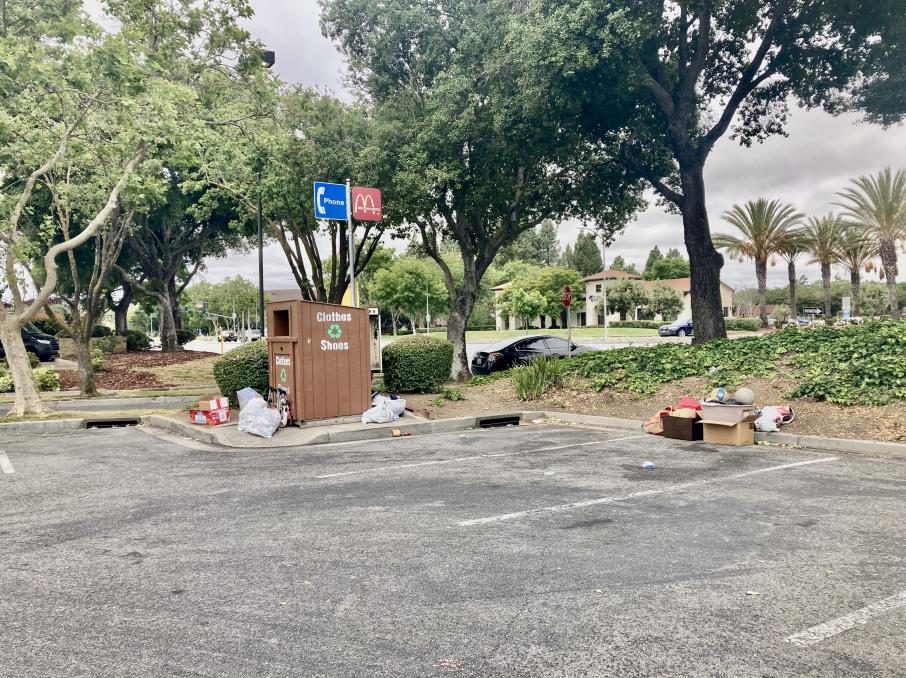
Clothing bins are everywhere, and most people assume each one belongs to a charity. Many are run responsibly. Others are dropped in parking lots without the landowner’s permission, emptied rarely, and left to overflow. Before Houston acted, Vice Mayor Pro Tem Martha Castex-Tatum’s office found that more than half the bins in her District K had been placed without the property owner’s permission.6
“Unfortunately, these donation boxes many times become havens for illegal dumping.” Vice Mayor Pro Tem Martha Castex-Tatum, Houston City Council, May 5, 20216
Blight isn’t the only cost. State consumer agencies warn that a charity’s name on a bin doesn’t always mean your donation supports that charity. In 2025, Connecticut’s Department of Consumer Protection said that “many for-profit bins are illegally placed” and mislead donors.11,12
of textiles generated in the U.S. in 2018.9
of textiles sent to landfills that year.9
the national recycling rate for textiles.9Source: U.S. EPA, latest national data (2018).
Done right, a donation bin is the front door to reuse. Done wrong, it’s a magnet for dumping. The difference is accountability.
What Ordinance 2023-151 does.
Houston first regulated donation boxes in 2021.6,8 Ordinance 2023-151 extends those rules to a larger, better-equipped category, the donation station, and updates the rules for every box and station in the city.1
Official title: “An Ordinance amending Chapter 28 of the Code of Ordinances, Houston, Texas, and the Houston Building Code (Chapter 1 of that volume of the City of Houston Construction Code known as the City of Houston Building Code) relating to the regulation of donation stations; containing findings and other provisions relating to the foregoing subject; providing for severability; and declaring an emergency.”1 The tags on each card show the ordinance section and the City Code section it amends.
- Ord. §§4–5 · Code §§28-632, 28-633
No permit, no bin.
It shall be unlawful for any person to place or maintain a donation box or donation station at any location within the city unless done in accordance with a valid permit.
Property owners and tenants are also barred from allowing an unpermitted unit on their land. - Ord. §8 · Code §28-641(a)
The property owner says yes, in writing.
Every application must show that the applicant owns the site or include the landowner’s written permission. It also needs a scaled site plan, a service plan with pickup days and times, a description of the unit, proof of insurance and contact details for the landowner and operator.
- Ord. §§8–10, 19 · Code §§28-641 to 28-643
One permit, one unit, one address.
Each box or station needs its own permit, valid only at its listed address. Permits expire after one year, carry a $55 annual fee, can’t be transferred, and come with a decal that must stay visible. Changes must be reported within ten days.
- Ord. §13 · Code §28-651(1)–(3)
Who to call is on the box.
Current operator contact information must always be displayed. So must a valid decal, visible from the street, and a clear list of accepted items with the rule that all donations must fit inside.
- Ord. §13 · Code §28-651(4)–(13)
Safe, sensible placement.
Paved surfaces only, at least 25 feet from the adjacent right-of-way, with a parking space for donors. Never in the right-of-way, setbacks, landscape buffers, drainage or utility easements, floodplains, driveways, fire lanes or drivers’ sight lines. Generally one unit per property.
- Ord. §§13–14 · Code §§28-651(15)–(16), 28-652
Keep it clean, inside and out.
Nothing may be collected or stored outside the unit. The operator and the landowner must keep the area within 25 feet free of trash, debris and dumped items, on the pickup schedule they filed.
- Ord. §§11, 13 · Code §§28-644, 28-651(17)–(18)
Insured and accountable.
Operators carry at least $1,000,000 in commercial general liability insurance with the City as an additional insured, indemnify the City, and comply with Texas’s donation-receptacle disclosure law.
- Ord. §§3, 8, 13, 15 · Code §§28-631, 28-641(b), 28-651, 28-653
A higher standard: the donation station.
A donation station is an unattended, video-monitored receptacle connected to its own power equipment. It must be steel and must be:
- monitored 24 hours a day by attached security cameras;
- lit to at least six foot-candles around the station;
- powered by a storage battery charged primarily by solar panels.
Applicants must also describe the station’s cameras, lighting, power system and accessibility for people with disabilities. Stations may be up to 1,360 cubic feet and 160 square feet, versus 120 cubic feet and 50 square feet for a box.
- Ord. §§16–17 · Code §§28-656, 28-657
Fast cleanup, with teeth.
After notice, owners have five business days to fix a violation. Then the City may fix it, revoke the permit, or remove and impound the unit, and it can recover its costs through a lien on the property. Units placed without the landowner’s consent or blocking the right-of-way can be removed without notice. Health hazards such as vermin, mosquito breeding, bedbugs or leaking contents may be abated immediately, and violations carry fines of up to $2,000 a day.
- Ord. §§9–10 · Code §§28-642(c), 28-643(b)–(e)
Fair process, and no zombie permits.
Operators get written reasons and a hearing before an appointed hearing officer if a permit is denied or revoked. Permits can be revoked for false applications or violations, or after 180 days of disuse, and a revoked permit can’t be reissued for a year. Revoking one permit doesn’t affect an operator’s other permits.
- Ord. §7 · Code §28-634
Not a place to live.
It is unlawful to occupy a donation station as living quarters.
- Ord. §18 · Houston Building Code §105.2
Good units, less red tape.
The Building Code now exempts donation stations up to 160 square feet and donation boxes up to 50 square feet from needing a separate building work permit, so a compliant unit can be installed and maintained efficiently.
Read the full ordinance.All 16 pages as signed by Mayor Sylvester Turner on March 1, 2023, including the Council’s findings, the fee schedule and the vote record.
Download the ordinance (PDF)Houston wrote its rules around a working example.
Most bin laws are written only to stop bad actors. Houston’s 2023 amendment did that too. It also made room for a better kind of collection point, after council members saw one up close.
A foundation, a champion and the law.
- A foundation. At Castex-Tatum’s request, the City’s Administration & Regulatory Affairs Department (ARA), City Attorney’s Office, Solid Waste Department and Houston Public Works drafted Houston’s first donation-box rules. A stakeholder meeting followed in December 2020, and Council adopted the rules unanimously in May 2021.6,7
- A champion. Castex-Tatum led the effort. Colleagues thanked her from the dais for her “leadership on this issue.”5
- The drafting. The 2023 amendment was requested by ARA Director Tina Paez and prepared by the City’s Legal Department.1
- The vote. Council adopted it on March 1, 2023, and it took effect immediately.1,3
A working model, an open door and proven practices.
- A working model. By the time of the vote, GEF’s Neighborhood Donation Recycling Stations were in seven of Houston’s 11 council districts, Castex-Tatum told Council.5
- An open door. In November 2022, GEF representatives met with Castex-Tatum’s team and gave them a tour of the stations.4,5
- Proven practices. Before the vote, Castex-Tatum described how the stations work: 24-hour cameras, immediate cleanup when debris appears, no-dumping signs that warn of a fine, and a toll-free number on every station.5
The new “donation station” category describes, feature for feature, the kind of station council members toured: video-monitored, lit, steel, and powered by its own solar battery. Council Member Abbie Kamin thanked the Mayor “for the partnership with this foundation to get these going.”5
- Dec 17, 2020
Stakeholders meet
City departments meet with stakeholders on proposed donation-box rules.7
- May 5, 2021
- Nov 2022
- Feb 23, 2023
The amendment is drafted
The City Legal Department prepares the donation-station ordinance at ARA’s request.1
- Mar 1, 2023
- May 2024
Results
GEF reports that since the ordinance passed, it has diverted 1,032,624 pounds of used textiles from landfills in Houston, and 5,893,421 pounds across Texas that year.13
“You can see the difference.”
Before the vote, council members explained why the rules work and why they welcomed the stations.
Remarks on Agenda Item 13, March 1, 2023. HTV broadcast excerpt posted by Green Education Foundation. Watch on YouTube5
“What we found in District K, since we’ve implemented the donation box ordinance, is the orphan donation boxes that tend to be magnets for illegal dumping have disappeared.”
“They’ve done a really good job of thinking through all of the things that have caused us anxiety with these boxes.”
“It’s not just benefiting District K, it’s benefiting the entire city…”
“When driving around in neighborhoods, you can see the difference.”
Seven reasons this belongs in every city code.
Every city has donation bins, and most have had trouble with some of them. Houston’s approach works because it doesn’t ban bins. It sets standards and holds every unit to them.
It ends orphan bins.
Every unit has a permit, a decal, a named operator and a filed pickup schedule. In District K, Castex-Tatum reported that orphan boxes “have disappeared” under Houston’s rules.5
It protects property owners.
No bin goes in without the owner’s written consent, and a bin placed without consent can be removed without notice. Owners share responsibility for upkeep, so consent means something.
It protects donors.
Operator contact information on every unit, and compliance with state donor-disclosure law, tell donors who they’re giving to. Texas law already requires for-profit bin operators to post their name, address and phone number.10
It keeps textiles out of landfills.
Americans landfill about 11.3 million tons of textiles a year, and only 14.7% are recycled.9 Removing bad bins while welcoming well-run ones keeps convenient drop-off points in neighborhoods instead of eliminating them.
It costs taxpayers little.
Permit fees, insurance naming the City, indemnity and cost-recovery liens put the cost of enforcement on the operators who cause problems, not on residents.
It’s fair to every accountable operator.
The rules regulate conduct, not identity. A charity, a Tribe, a small independent collector or a business that meets the published standards can get a permit, with written reasons and a hearing if one is denied or revoked.
It raises the bar, not the barriers.
Houston defined a higher standard (monitored, lit, solar-powered) and cleared a path for it by waiving a separate building permit for compliant units.
GEF’s viewThe right way to regulate collection.
In GEF’s view, Houston shows how to regulate textile collection well. Set clear, published standards. Enforce them evenly. Then let every accountable operator compete to serve the public.
That is the same principle behind the protections GEF supports for independent collectors in California, where SB 707 gives one organization control over who may collect and on what terms. Local rules like Houston’s keep accountability local and keep the door open to small, Tribal and community collectors. Read about SB 707 →
A playbook for the Houston model.
Houston’s approach can be adapted by almost any city or county. Start with what’s already in your code, then add what’s missing.
Lead it.
- Ask staff for the number of bins in your district and the complaints and dumping calls tied to them.
- Visit a well-run station and a problem site, as Houston’s council members did.
- Ask your city attorney to adapt Houston’s Chapter 28, Article XIX, using the checklist below.
- Hold a stakeholder meeting with operators, property owners and neighbors.
- Sponsor the ordinance with a grace period so existing operators can comply. Houston gave four months in 2021.6
Build it.
- Choose the permitting office. Houston uses its Administration & Regulatory Affairs Department.
- Check fit with zoning, right-of-way, floodplain and building-code rules.
- Set a fee that covers administration, and create decals and a public permit list.
- Route bin complaints through 311 into a notice, cure and abatement workflow.
- Align the text with your state’s donation-receptacle and charitable-solicitation laws.
Start it.
- Photograph problem bins and note their locations and dates.
- Ask property managers whether they approved the bins on their lots.
- Send this page and the ordinance to your council member.
- Invite responsible operators to present to your neighborhood group or council.
- Speak during public comment when the ordinance is heard.
Checklist: the model’s core provisions
Use this as a drafting outline. Section numbers refer to Houston’s Code of Ordinances, Chapter 28, Article XIX, as amended by Ordinance 2023-151.
- Definitions for donation boxes and the higher-standard donation station§28-631
- A permit to place a unit, and a permit required before an owner allows one§§28-632, 28-633
- Written landowner consent with every application§28-641(a)(2)
- A site plan and a service (pickup) plan§28-641(a)(3)–(4)
- One permit per unit and address, renewed yearly, nontransferable§§28-641(d)–(e), 28-643(a)
- A visible decal and posted operator contact information§§28-642(b), 28-651(1)–(2)
- Accepted items posted, and nothing left outside§28-651(3), (15)
- Placement limits: paved, off the right-of-way, out of easements, floodplains and sight lines§28-651(4)–(9), (12)–(13)
- Size limits and one unit per property§28-651(10)–(11)
- A 25-foot clean zone shared by operator and landowner§28-651(16)
- $1 million liability insurance naming the city, plus indemnity§§28-644, 28-651(17)
- Compliance with state donor-disclosure law§28-651(18)
- Station standard: 24/7 cameras, lighting, solar-battery power, steel, accessibility§§28-641(b), 28-651(14), 28-653
- Notice and a five-day cure, then removal, impoundment and cost-recovery liens§28-656
- Immediate abatement of health hazards, with fines up to $2,000 a day§28-657
- Written reasons, a hearing and an appeal for denials and revocations§§28-642(c), 28-643(d)
- Permits lapse after 180 days of disuse§28-643(b)(4)
- A building-permit exemption for compliant unitsHouston Building Code §105.2
Houston’s 2023 ordinance amends its 2021 donation-box ordinance (No. 2021-0350), so cities starting from scratch will want to review both. Houston’s text cites Texas statutes and Houston code sections; adapt them to your state’s law with your city attorney. This page is public education, not legal advice.
Bring the Houston model to your community.
Questions about the ordinance, or about how donation stations work? Write to us.
Green Education Foundation is a 501(c)(3) public charity. This page is provided for public education and is not legal advice. The City of Houston has not reviewed or endorsed this summary.
Frequently asked.
Is this a resolution or an ordinance?
Does it ban donation bins?
No. It requires a permit for every box and station and sets standards for where they go and how they’re maintained. Units that follow the rules are welcome.
Does it only allow GEF’s stations?
No. Any operator that meets the standards can apply for a permit. GEF’s Neighborhood Donation Recycling Stations are one example of the donation-station type.
What does a permit cost?
The ordinance set an annual fee of $55 per donation box or donation station.1 Check the City of Houston’s current fee schedule for today’s rate.
What happens to a bin placed without permission?
A box or station placed without the landowner’s consent, or one blocking the right-of-way, can be removed and impounded without advance notice. If the owner doesn’t reclaim it and pay the City’s costs within 30 days, the City may dispose of it.1
Can my city copy it word for word?
Use it as a model, not a template. Houston’s text cites Texas statutes, such as the Health and Safety Code and the Business and Commerce Code, and Houston-specific code sections. Your city attorney will need to adapt those to your state and local code.